
 Green malkoha, St Lucia It has been a great birding month again with a mixed bag of weather. The August winds have certainly arrived on time this year! In between the many blustery days though we have had some perfect warm days hinting at the arrival of Spring. In the forest, the White stinkwood trees have started pushing out their new leaves which are fed on by the countless larvae of Celtis leaf beetle- an annual occurrence at this time of year.  White stinkwood trees with Clusters of Celtis leaf beetle larvae on trunks (Brown patches) This coincides with an influx of African emerald cuckoo and Klaas' cuckoo which have both been pleasantly common throughout the month.  African emerald cuckoo, St Lucia Flowering Coral trees are still attracting good numbers of Collared, Eastern olive, Grey and Purple-banded sunbirds as well as Eastern golden weaver.  Purple-banded sunbird in flowering Coral tree The first Narina trogon males started calling towards the middle of the month making these spectacular birds easier to find. They are silent in non-breeding season from late summer until late Winter.  Narina trogon male calling, St Lucia Seed-eaters such as Grey waxbill, Red-backed mannikin, Green twinspot, Bronze mannikin and Yellow-fronted canary have been attracted to areas of seeding Beefwood/Casuarina trees, sometimes in mixed flocks of 30 or more individuals.  Green twinspot We have enjoyed regular sightings of Spotted ground-thrush throughout the month- one confiding individual has been treating us with close-up sightings! With an estimated global population of fewer than 2500 individuals it is always a privilege to see these beautiful birds! A highlight in the forest towards the end of the month was a sighting of 2 Eastern Bronze-naped pigeon. These rare pigeons are synonomous with forests such as Dlinza and Ongoye so seeing them in St Lucia is a rare treat. Having said this, there have been a handful of sightings in recent years- all in late Winter and early Spring- which may hint at some seasonal movement of these birds to the coastal forests of St Lucia.  Eastern bronze-naped pigeon in St Lucia There have been big changes at the St Lucia estuary mouth during the course of the month with the mouth finally closing after the dry Winter we have had. The long-staying Eurasian oystercatcher has remained at the mouth and another highlight was 2 sightings of African finfoot during the course of the month.  Eurasian oystercatcher, Lake St Lucia estuary mouth At the estuary edges we have enjoyed regular sightings of Mangrove kingfisher which will soon be departing back to their Summer breeding grounds in the Eastern Cape.  Mangrove kingfisher, St Lucia estuary The wetlands surrounding St Lucia and in the Isimangaliso Wetlands Park have continued to shrink and provide easy pickings for herons, egrets, spoonbills, kingfishers and reed cormorants. Amazingly, the one wetlands complex is frequented by at least 6 Rufous-bellied heron - a bird still considered to be rarity in South Africa.  Rufous-bellied heron, Eastern shores, Isimangaliso Wetlands Park. Another highlight in the wetlands has been a juvenile Allen's gallinule- also a rarity to the area- which has been present on a wetland on the Eastern shores for most of the month.  Allen's gallinule, Eastern shores, Isimangaliso Wetlands Park As is usual for this time of year, large areas of coastal grassland have been burnt.  Fires on the Eastern shores, Isimangaliso Wetlands Park Freshly burnt areas are attracting a nice variety of raptors including African cuckoo-hawk, Martial eagle, Brown, Black-chested and Southern-banded snake-eagle, Bataleur and Black-shouldered & Yellow-billed kite. Good numbers of Senegal lapwing are also present in some of the burnt areas.  African cuckoo-hawk staking out freshly burnt grassland Other highlights in the grasslands have included good numbers of Collared pratincole and- closer to Cape Vidal- the Yellow-billed oxpecker which have been seen regularly on herds of buffalo.  Collared pratincole, Isimangaliso Wetlands Park Lastly, we have once again enjoyed numerous leopard sightings during the course of the month. St Lucia and the Isimangaliso Wetlands park proving to be a fantastic place to see these beautiful predators.
0 Comments
 African emerald cuckoo in St Lucia It has been an exceptional birding month in St Lucia with fantastic sightings in all the different habitats. At this time of year in the forests most of the White stinkwood trees and Large leaved fig trees have shed their leaves allowing more light to infiltrate through the canopy meaning the forest is less gloomy, affording better photographic opportunities. Action in the forest has been centred around the fruiting fig trees, Wild plum trees, Sand apricot vines and Pigeonwood trees which have been attracting large numbers of frugivores including Trumpeter hornbill, Black-bellied starling, White-eared barbet, Yellow-bellied greenbul, Livingstone's turaco and Crowned hornbill.  Crowned hornbill feasting on figs On the forest floor we have enjoyed regular sightings of Winter-visiting Spotted ground-thrush, Chorister robin-chat and White-starred robin as well as resident Brown scrub-robin, Buff-spotted flufftail, Lemon dove, Red-capped robin-chat and Terrestrial brownbul.  Spotted ground-thrush in St Lucia Roving bird parties have been quite spectacular in the forest this month with sometimes overwhelming numbers of species. Regular species present in the bird parties have included Olive bush-shrike, Orange-breasted bush-shrike, Green malkoha, Dark-backed weaver, Black-backed puffback, Rudds apalis, Yellow-breasted apalis, Black cuckooshrike, Green-backed camaroptera, Black-throated wattle-eye, Blue-mantled crested flycatcher, Square-tailed drongo, African paradise flycatcher and the odd Narina trogon.  Narina trogon in St Lucia. Flowering Coral trees, Tree fuschia and Cape honeysuckle have continued to attract good numbers of Purple-banded, Grey, Eastern olive and Collared sunbirds. Seed-eaters have been concentrated around seeding Casuarina (Beefwood) trees this month with nice mixed flocks of Green twinspot, Red-backed mannikin, Bronze mannikin, Yellow-fronted canary and Grey waxbill often present in the vicinity. With a relatively dry Winter thus far the wetlands have receded around St Lucia and in the Isimangaliso Wetlands Park. The smaller, shallower wetlands are providing easier pickings for herons (Grey, Black-headed, Squacco, Rufous-bellied), little bittern, Egrets (Great white, Intermediate, Little), African spoonbill, Hamerkop and Sacred Ibises as aquatic organisms are more concentrated and easier to hunt, attracting good numbers of these birds.  Rufous-bellied heron on the Eastern shores, isimangaliso Highlights in the wetlands have included regular sightings of a pair of Rufous-bellied heron as well as regular open views of the normally secretive Little bittern.  Little bittern hunting out in the open The last-remaining deeper wetlands are also holding more concentrated numbers of waterfowl such as African pygmy-goose, White-backed duck, White-faced whistling duck, Yellow-billed duck, Red-billed & Blue-billed teal and the odd Lesser moorhen.  Lesser moorhen in the wetlands close to St Lucia Other highlights on the Eastern shores during the month have included Collared pratincole which are visible at wetland edges or on the road if one is lucky, Saddle-billed stork, African cuckoo-hawk, Southern-banded snake eagle and African crowned eagle.  Collared pratincole on the Eastern shores, Isimangaliso. Huge baitballs of sardine have been lingering around Cape Vidal throughout the month attracting good numbers of Cape cormorant, Cape gannet and Greater crested tern.  Cape cormorant and Greater crested terns at Cape Vidal A Parasitic jaeger (not a bird often seen perched ashore in KZN) has been harassing terns and gulls at Cape Vidal for their food- typical behaviour from this kleptoparasitic bird. Amazingly it has also been perching ashore (often seperate to the tern roost because it gets mobbed by them if it ventures too close). Other interesting sightings from shore at Cape Vidal included Indian Yellow-nosed albatross and Brown booby. Also of interest, in St Lucia, a Wilson's storm-petrel was seen flying in the channel between the beach and backline- a bird usually seen much further off shore.  Parasitic jaeger perched on Cape Vidal beach The Lake St Lucia estuary mouth and narrows have produced some great sightings during the course of the month with regular sightings of the Eurasian oystercatcher which is often in the company of African (Black) oystercatchers.  Eurasian oystercatcher with African (Black) oystercatchers Lastly, in the narrows section of the Lake St Lucia estuary we enjoyed multiple sightings of African finfoot during the course of the month as well as some great Mangrove kingfisher sightings.  Mangrove kingfisher in St Lucia  African finfoot, St Lucia Narrows  African pygmy-goose It was a relatively wet June in St Lucia with approximately 100mm of rain falling during the month. Nevertheless, the wetlands have continued to shrink and the shallow remaining pans with more concentrated, easy to catch invertebrates, frogs and fish are attracting a nice variety of predatory waterfowl including Squacco heron, Saddle-billed stork, Striated heron, Little bittern, Great white, Intermediate and Little egret, Black-headed heron, Grey heron, African spoonbill, Hamerkop, Saddle-billed stork and Wooly-necked stork to name a few. There are also abundant African pygmy-goose, White-backed duck, White-faced whistling duck, Red-billed teal and the odd Blue-billed teal along with African jacana, Black crake, Reed cormorant and the odd patrolling African marsh-harrier.  Saddle-billed stork One of the highlights of the month has been the regular sightings of Rufous-bellied heron on the Eastern shores of Isimangaliso Wetlands Park.  Rufous-bellied heron, Eastern shores Isimangaliso Wetlands park Another highlight has been the regular sightings of a Eurasian oystercatcher on the St Lucia beaches which has been in the company of African (Black) oystercatchers.  Eurasian oystercatcher, St Lucia beach Forest birding has been fantastic with regular sightings of Green malkoha, Olive bush-shrike, Blue-mantled crested flycatcher, Woodward's batis, Rudd's apalis, Eastern nicator, Buff-spotted flufftail, Spotted ground-thrush, Black-throated wattle-eye, Brown scrub-robin, Livingstone's turaco, Grey sunbird, Purple-banded sunbird and the odd White-starred robin (to name a few)  Sub-adult White-starred robin At the estuary there has been a large tern roost present consisting predominantly of Greater crested terns with the odd Caspian, Sandwich and Little tern in the mix. The Western osprey has continued to show consistently as it hunts over the mouth and we have even enjoyed a sighting of African finfoot opposite the mouth in recent days! The Palm-nut vulture have also given us nice sightings on St Lucia beaches during the course of the month.  Palm-nut vulture exiting Casuarina tree bordering St lucia's beaches.  The spectacular and diverse landscape of the Isimangaliso Wetlands park. Often referred to as the most diverse Natural protected area in Africa, The Isimangaliso Wetlands Park stretches from Mapelane South of St Lucia to the Mozambique border. The entire length of coast (approximately 220km in length) is a marine protected area and protects stunning coral reefs (accessible to divers at Sodwana Bay) as well as many protected bays (such as Cape Vidal, Mabibi and Lala nek ) where snorkeling is possible from shore on the low tide.  The Isimangaliso Wetlands Park protects stunning, pristine Coral reefs such as at Sodwana Bay. Marine life is stunning and diverse with approximately 1200 species of fish recorded in the Isimangaliso Marine protected area along with Octopus, Lobsters, Nudibranches and other marine life. The healthy marine ecosystem attracts a wide array of pelagic bird species such as Indian yellow-nosed albatross, Shy albatross, Black-browed albatross, White-chinned petrel, Wilson's storm petrel, Sooty shearwater and Brown skua to name a few.  Protected bays such as Cape Vidal, Mabibi, Lala neck and Sodwana bay offer great snorkelling from shore In the Winter months the coastline is visited by migrating Humpback whales which leave the frozen ocean at Lower latitudes (where they feed on krill) to shelter in the warm waters of the Mozambique (Agulhus) current. Their numbers continue to increase annually and during peak whale season (July to September) it is virtually guaranteed that you will see them from shore at places like Cape Vidal, Mission rocks and St Lucia. For closer views, there are Whale watching boat tours which depart from St Lucia on a daily basis during whale season.  Humpback whales are a common sight off the Isimangaliso Wetlands Park in the Winter months and early Spring. In the summer months, the beaches to the North of St Lucia provide a safe nesting ground for Leatherback and Loggerhead turtles. Amazingly, female turtles return to nest on the same beaches that they hatched on, even though they may venture many thousands of kilometres away. Females lay multiple clutches of eggs per season high up on the beaches to protect their nests from large storm swell (typical in the summer months due to large cyclones/Tropical storms out at sea). The beaches of the Isimangaliso Wetlands Park are of critical importance because human interference at other suitable nesting beaches has dramatically reduced available nesting habitat for these endangered marine turtles on the African mainland.  Loggerhead turtle hatchlings emerging from the sand, Bhanga nek beach. The intertidal zone consisting of rocky shores and sandy beaches is frequented by a wide variety of shorebirds such as African (black) oystercatcher, Eurasian whimbrel, Sanderling, White-fronted plover, Grey plover, Ruddy turnstone as well as thousands upon thousands of Ghost crabs.  African (Black) oystercatcher are found on the beaches of the Isimangaliso Wetlands Park. Eurasian oystercatcher is a rare vagrant. The intertidal rock pools at places such as Mission rocks (accessible on the low tide) protect a stunning variety of marine life and it is also not uncommon to see Green turtles swimming in the channel just off the rock ledge.  Green turtle coming up for a breath off the Mission rocks rock ledge. On a walk down one of the pristine sandy beaches it is not uncommon to see Leopard, Hippo, Spotted hyaena and Honey badger tracks , Red duiker and Bushbuck on the dunes or Bottle-nosed dolphins surfing the waves out at backline.  Bottle-nosed dolphins surfing the waves at Mission rocks, Isimangaliso Wetlands Park. The large forested sand dunes which line the coastline are covered (on the landward side) by a unique habitat type within South Africa known as Dune forest. The Dune forest is home to many unique and very localized species of mammal, bird, reptile and invertebrate. Some special bird species include Southern-banded snake eagle, Woodward’s batis, Rudd’s apalis and Livingstone’s turaco.  The beautiful Dune forest which skirts the whole Isimangaliso Wetlands Park coastline (over 220km!) Other Dune forest specials include Gaboon adder, Tonga red bush squirrel, Setaro's dwarf chameleon, Red duiker and Samango monkey.  The brilliantly camouflaged Gaboon adder, an inhabitant of Dune forest The coastal grasslands and waterlily-covered wetlands which lie to the West of the Dune forest support an amazing diversity of waterfowl and grassland species with some special bird species including Rosy-throated longclaw, African pygmy goose, Denhams bustard, Swamp nightjar and Collared pratincole to name a few.  Swamp nightjar on the Eastern shores of Isimangaliso Wetlands Park. The grasslands are bisected by small streams and drainage lines which are lined by another unique habitat type in South Africa called Swamp forest which supports it's own unique fauna and flora.  The Flora of Swamp forest differs from Dune forest and consists of tree species which can tolerate occassional flooding. The understory is dominated by fern species. The Eastern shores of Lake St Lucia- once riddled with exotic plantations- has been rehabilitated and large game which was hunted out historically has been reintroduced. There are now healthy populations of Elephant, Buffalo, White and Black Rhino, Leopard, Spotted hyena and a wide range of other ungulates such as Common reedbuck, Waterbuck, Bushbuck, Kudu, Blue Wildebeest, Warthog and Red duiker.  The Eastern shores of Isimangaliso Wetlands Park supports a healthy leopard population. Another unique and outstanding feature of the Isimangaliso Wetlands Park are the estuarine lakes found a few kilometers inland of the ocean. The largest of these is Lake St Lucia which is connected to the ocean (sporadically) via a long channel known as 'the Narrows' .  Lake St Lucia visible from the False bay section of Isimangaliso Wetlands Park. The estuary mouth is situated just to the South of St Lucia and is a dynamic and ecologically important area which supports a stunning variety of Shorebirds, Waterfowl and waders. When open, the mouth is utilized by a wide variety of estuarine and marine fish species such as River bream (Perch), Kob, Mullet, Spotted grunter and Kingfish.  Blue-cheeked bee-eater at the Lake St Lucia estuary mouth (Maphelane forested sand dune in the background) A large roost of terns (and other shorebirds) is usually present at the estuary mouth with numbers fluctuating according to season and food availability. In the Summer months there are typically 6 to 7 tern species present with usually a few less in the Winter months.  Tern roost at the Lake St Lucia estuary mouth The Lake St Lucia estuary mouth is also famous as one of few places where it is possible to see Crocodiles, Hippopotamus and Bull sharks swimming in the same waters!  Bull shark hunting at the Lake St Lucia estuary mouth. During the Winter months the estuary edges are home to visiting Mangrove kingfisher which migrate up the coast from the Eastern Cape. There are only a few hundred individuals within South Africa and the Lake St Lucia estuary provides an important non-breeding ground for these beautiful birds.  Mangrove kingfisher, St Lucia Lake St Lucia itself is an important nursery ground for many estuarine/marine fish species as well as prawns. It is also home to the unique amphibious mudskipper fish which can survive prolonged periods of time outside the water.  Lake St Lucia and the 'Narrows' is home to the unique amphibious fish- Mudskipper The abundance of fish in the lake attracts a large variety of piscivorous bird species such as Pink-backed & Great White pelican, Caspian tern, Goliath heron, African fish-eagle and Western osprey to name a few. In dry periods when the lake edges are shallow, large flocks of Greater and Lesser flamingo gather to feed.  Large mixed flocks of Greater & Lesser flamingo gather at Lake St Lucia when conditions are suitable. Lake St Lucia also supports some of the largest populations of Hippopotamus and crocodile in the country. St Lucia town is famous for having it's resident pods of hippo saunter into town in the evenings to graze on short lawn grass at the verges of roads and in people's gardens.  Classic St Lucia- a hippo grazing grass in town! To the west of Lake St Lucia lies the Western shores and False bay sections of the Isimangaliso Wetlands Park. The Western shores protects a similar variety of habitats to the Eastern shores with a few slight differences such as Lala palm studded grasslands, Tall woodland and the odd sandforest patch. As a result the Western shores is better for birds such as Lemon-breasted canary and Pink-throated twinspot.  Lemon-breasted canary are more common on the Western shores of Isimangaliso Wetlands Park due to a higher density of Lala palms (Their nesting site) Large game has also been reintroduced to the Western shores and in addition to all the species occurring on the Eastern shores, it also supports populations of Nyala, Giraffe and Tsessebe. Recently, the Western shores has also become famous for its population of 'Strawberry leopard'- a rare genetic abnormality whereby leopards lack black pigment and as a result their rosettes are reddish in colour instead.  Strawberry leopard on the Western shores, Isimangaliso Wetlands Park. The False bay section of the Isimangaliso Park protects beautiful tracts of Sandforest and lakeshore on the North-Western edge of Lake St Lucia. With no dangerous game, this area can be explored on foot or mountain bike via one of the stunning trails.  The beautiful Mphophomeni trail in the False Bay section of Isimangaliso passes through stunning sandforest The sandforest areas in particular, are a birding hotspot protecting many rare and localised species such as African broadbill, Gorgeous bush-shrike, Eastern nicator, Rudd's apalis, Purple-banded & Neergaards sunbird to name a few.  African broadbill is a sandforest special found in the False bay section of the Isimangaliso Wetlands park. The Lake and lake shore in the False bay section, besides being tranquil and picturesque, offer great birding for waterfowl.  Pink-backed pelican, Lake St Lucia, False Bay section. The Mkhuze section of the Isimangaliso Wetlands Park protects a wide range of habitats all crammed into a relatively small area of 400sq/km. Habitats include the foothills of the Lebombo mountains, Bushveld, Tall woodland, Ox-bow lakes, Riparian forest and Sandforest. The amazing diversity of habitats crammed into a small area makes Mkhuze a birding mecca, with over 400 species of bird recorded in the reserve. Mkhuze is famous as one of the best locations to see the rare and elusive Pel's fishing owl which can be found in the lush Riparian forest along the banks of the Mkhuze river and oxbow lakes. The guided Fig-forest walk gives the best chance of seeing this impressive owl. Sand forest areas protect many unique bird species such as Neergaard's sunbird, African broadbill, Eastern nicator, Bearded scrub-robin and Pink-throated twinspot.  Male and female Pink-throated twinspot close to Kumsinga hide in Mkhuze Large game has also been reintroduced to the reserve over the years and it is now home to Lion, Leopard, African Wilddog, Cheetah, Elephant, Buffalo, Black and White rhino and a wide variety of ungulates.  Cheetah feasting on it's Red duiker prey in the Mkhuze section of the Isimangaliso Wetlands Park The small and secretive Suni antelope is one of the special mammal species found in the park which is restricted to Sand forest habitat and therefore very range-limited and localised in South Africa.  Suni antelope - a sand forest resident. A nice variety of well-placed hides overlooking waterholes and the oxbow lakes provide excellent photographic opportunities for birds and animals. The hides overlooking waterholes are particularly productive in the drier Winter and Spring months when parched animals and birds come to quench their thirst.  A typical dry season scene at one of Mkhuze Game reserve's fantastic hides North of Sodwana bay the Coastal forest section of the Isimangaliso Wetlands park skirts the coastline all the way up until the Mozambique border. This stretch of coast is characterised by many beautiful remote beaches and protected bays such as Mabibi, Rocktail bay, Lala nek, Black rock, Dog point and Bhanga nek which all offer fantastic snorkeling on the low tide.  Dog point The Maputaland turtle sanctuary is found within this section of the park and forms the core protected area for nesting Leatherback and Loggerhead turtles- the highest density of which can be found nesting between Bhanga nek and the Mozambique border. The turtle research and monitoring programme here is the longest-running in the world and the source of much of the information we know about marine turtles- something to be proud of!  Loggerhead turtle female returning to the water after laying eggs- Bhanga nek West of Mabibi is the beautiful and tranquil Lake Sibaya- a large freshwater lake seperated from the ocean by the impressive forested sand dunes. The lake is home to hippo and crocodiles and some unique fish species. The short grassy, damp shoreline of the lake is a good area to search for Rosy-throated longclaw. 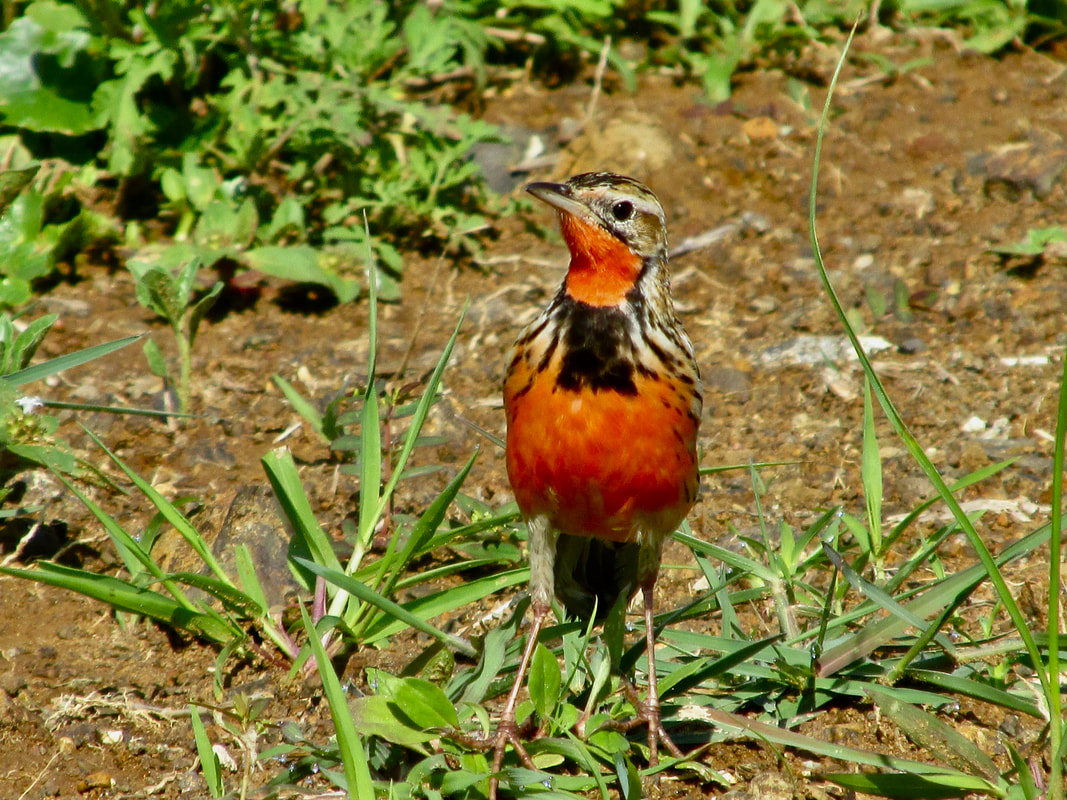 Rosy-throated longclaw Another impressive feature of this stretch of coast is 'Island rock'- a large island of reef which is exposed on the low tide and juts out above the ocean 50m off the shore. The Western 'inside' section of the reef is very sheltered from swell which allows corals to thrive- creating a beautiful underwater aquarium.  Beautiful coral reef- Island rock The 4 Kosi Lakes are another outstanding feature of the coastal forest section of the Isimangaliso Wetlands Park. The Lakes are all connected by channels and also connected to the ocean at the Kosi mouth. A traditional and sustainable form of fishing developed 700 years ago is still used by the Tonga people living alongside the lake- an interesting cultural feature of the lake.  The beautiful Kosi Lakes with traditional fish kraals visible. The Kosi mouth is an extraordinary area which protects a stunning diversity of marine and estuarine life. It has been nicknamed the 'aquarium' as a result and provides some breathtaking snorkelling.  Stonefish at the Kosi mouth It is also possible to snorkel in the first and second lake on a guided boat trip where it is possible to see Mangrove snapper, Glassy, Moonies and other estuarine fish.  Moonies in 1st Lake Impressive Raffia palm forests are found in a few locations bordering the Kosi lakes and these are home to Palm-nut vulture. The Palm-nut vultures use the Raffia palms for nesting and roosting purposes and also eat the husk of the fruit. They are also regularly seen on the beaches to the East of the Kosi Lakes.  Palm-nut vulture on the beach The Isimangaliso Wetlands park is also a legendary fishing destination for shore anglers, ski fishermen and deep sea fishermen alike. Deep sea fishermen are permitted to catch pelagic species such as Tuna, King & Queen mackerel, Dorado, Wahoo, Sailfish, Marlin and Kingfish. Shore anglers target species such as Kob, Natal stumpnose, Spotted grunter, Garrick (Winter), Shad (Winter), Kingfish, Pompano and Perch.  River bream (Perch) caught at the Lake St Lucia estuary mouth For the surfers out there, there are various uncrowded breaks on offer at St Lucia, Cape Vidal, Mabibi, Black rock and Sodwana.  Surfing Cape Vidal The criteria for deciding on the top ten birds were as follows: The distribution of the bird should be restricted predominantly to Zululand and/or Zululand should be the best place to see them in South Africa. Very localized species such as Green barbet were given preference over more widely distributed birds. The scarcity and level of difficulty in finding the birds ranked birds higher than others. For example Green malkoha is much more difficult to find than Rudd's apalis. 10. Livingstone's turaco Livingstones turaco sunning itself after a rainy evening, St Lucia Livingstone’s turaco are only found within Zululand and into Mozambique. Their preferred habitat is Dune forest and as such are restricted to the narrow band of Dune forest skirting the Indian Ocean North of St Lucia and into the Isimangaliso Wetlands Park. St Lucia, Sodwana bay and Kosi bay are the best place to see them. These birds are relatively common in suitable habitat, especially areas with fruiting fig and Wild plum trees. Their nervous habits make them tricky to get good visuals of but they are very vocal (especially late afternoon) which helps in locating them. 9. Rudd's apalis Rudd's apalis in the forests of St Lucia Rudd's apalis are another species restricted to the Dune forest and sand forests of Zululand and into Mozambique. They are a very common and vocal species but their small size and furtive habits make them tricky to see. They favor areas with Dune thorn acacia and are often found in the company of the Yellow-breasted apalis which is much more confiding and conspicuous. 8. Woodward's batis Woodward’s batis are often described as the 'lazy' batis as they move less than the other batis species. They are often content to sit and call from the same position in dense foliage for long periods where their ventriloquil abilities make them difficult to locate. They are restricted to Dune forest and sand forest habitats skirting the coast of Zululand. St Lucia and the Isimangaliso Wetlands Park are the best place to see them. 7. Green malkoha The unique Green malkoha is found in thick forest tangles and don't like exposing themselves Although Green malkoha occur further South than the Zululand border, Zululand is most certainly the best place to see this secretive and elusive bird. Their preference for thick tangles at forest edge and skulking habits make them very tough to see. They are often members of bird parties so patient scanning of trees in bird parties is a good tactic in finding this bird. St Lucia and the Isimangaliso Wetlands Park are the best place to search for Green malkoha. 6. Pink-throated twinspot Pink-throated twinspot male, Mkhuze Game reserve. Pink-throated twinspot are best searched for in the sandforest areas of Mkhuze GR, Tembe Elephant Park and Bonamanzi but can also be found in dune forests of the Isimangaliso Wetlands Park at places such as St Lucia, Sodwana and Kosi Bay. They are often found in mixed flocks with other seedeaters such as Grey waxbill, Red-backed mannikin and Green twinspot. 5. Rosy-throated longclaw Rosy-throated longclaw on the Eastern shores, Isimangaliso Wetlands Park. Rosy-throated longclaw favour damp grassland, floodplains and wetland edge on the Coastal plain of Zululand. They occur sparsely and are nomadic according to rainfall and suitable habitat. Good places to see them are Nibela peninsula, Hluhluwe river floodplain, the shores of Lake Sibaya and the Isimangaliso Wetlands Park. 4. Southern-banded snake-eagle Southern-banded snake-eagle, Isimangaliso Wetlands Park. With only a few hundred individuals occurring in the Country, the Southern-banded snake-eagle is most certainly one of the most rare birds in South Africa. Their specific habitat preference of Dune forest restricts them to the far North-Eastern parts of Zululand with most individuals found in the extensive dune forests still remaining within the Isimangaliso Wetlands Park. The Eastern shores of Isimangaliso Wetlands Park and St Lucia are excellent places to search for this sparse and elusive bird. 3. Neergaard's sunbird Neergaard's sunbird Neergaard's sunbird are restricted to the Sandforests of Zululand in places such as Mkhuze game reserve, Tembe elephant Park, Ndumo and the False bay section of the Isimangaliso Wetlands Park. They are a discrete sunbird which is easily overlooked. 2. Plain-backed sunbird Plain-backed sunbird in the Sandforest of Tembe elephant Park. The Plain-backed sunbird is an extremely localised bird found in Sandforests and tall woodland only in the furthest Northern reaches of Zululand (and further North into Mozambique). The only reliable place to see them in the whole of South africa is the Tembe elephant Park and its surroundings. 1. Green barbet Green barbet in the beautiful Ongoye forest. One of the most localised birds in the country, the Green barbet is restricted to the Ongoye forest West of the small town of Mtunzini in Zululand. The next nearest population of Green barbet is Southern Malawi and Northern Mozambique making it one of the most amazingly isolated and disjunct population of birds in the country.
Theories why the Green barbet does not occupy other surrounding forests is supposedly due to the occurrence of a high density and diversity of Fig tree species in the Ongoye forest compared to other nearby forests. The Green barbet is synonymous with fruiting figs which are its almost exclusive food source.  Bar-tailed Godwit at the Lake St Lucia estuary mouth. It's been a very dry month in St Lucia compared to last May when we received approximately 300mm of rain. The Wetlands have continued to shrink and the grasslands have become a swathe of golden yellow. With the lack of rain and reduced outflow from the imfolozi River the estuary channel has become much shallower. Most of the summer terns have now left the estuary mouth with a few stragglers of Lesser crested tern still persisting amongst the many Greater crested terns and Caspian and Sandwich tern. As is usual for the Winter we have started to see Cape Gannet out at sea (amongst the first arriving humpback whales) and also more Kelp gull and the odd Cape cormorant. Other species present at the mouth area throughout the month included: Pink-backed pelican, Yellow-billed stork, Sanderling, Grey plover, Little egret, White-fronted & Kittliz's plover.  Caspian, Greater crested and Lesser crested terns at the Lake St Lucia estuary mouth The terns can rest easy these days with the absence of Yellow-billed kite but are still disturbed by the odd passing African fish-eagle and Western osprey.  Western osprey over St Lucia estuary mouth A nice surprise towards the end of the month was the discovery of a Eurasian oystercatcher which has joined a group of African Black oystercatchers on St Lucia beaches surrounding the Estuary mouth. Another nice surprise was a Bar-tailed godwit feeding amongst Eurasian whimbrels at the estuary mouth! Eurasian oystercatcher amongst Black oystercatchers In the forest we have enjoyed consistent sightings of Spotted ground thrush during the month and very reliable sightings of Buff-spotted flufftail in the latter part of the month. We have also enjoyed our first sightings of the season of the beautiful winter-visiting White-starred robin and Grey cuckooshrike. We also enjoyed somewhat unusual sightings of Brown-backed honeybird. Bird parties are nice and large after being beefed up by winter-visiting species such as Paradise flycatcher, Olive bush-shrike, Dusky flycatcher, Grey cuckooshrike and Black cuckooshrike. Early mornings are starting to become chilly and birds have started hunting the early morning sun which makes for good photographic opportunities. Frugivorous species such as Livingstone's turaco, Black-bellied starling, White-eared barbet, Trumpeter hornbill have been congregating around the last fruiting fig trees whereas sunbirds (Olive, Grey, Collared and Purple-banded) are congregating on the first flowering Tree fuschia and Cape honeysuckle.  Brown-backed honeybird in St Lucia The short cut grass on the road verges on the Eastern shores are holding good numbers of Senegal lapwing and Wetland areas good numbers of Pale-crowned cisticola.  Pale-crowned cisticola, Isimangaliso Wetlands Park Also of interest, Cuckoo hawk sightings have been nice and consistent on the Eastern shores during the month along with Southern banded snake-eagle, Brown snake-eagle and Black-chested snake-eagle.  African cuckoo hawk, Eastern shores, Isimangaliso  Palm-nut vulture, St Lucia. It has been a relatively dry month for rainfall and the wetlands have started to recede once again. Zululand autumn is typically still warm and balmy but you can definitely feel a bit of a chill in the morning's these days. Other signs of the approach of winter are the arrivals of some of our winter-visiting birds. The grasslands are once again full of African stonechat and an ever-increasing number of Senegal lapwing. At wetland edges we are starting to see Pale-crowned cisticola and at the forest/grassland ecotone Fiscal flycatcher and Spotted flycatcher.  Wetlands surrounding St Lucia covered in a carpet of beautiful waterlilies. In the forest we have started to see winter-visiting Olive bush-shrike and Chorister robin-chat. Besides those species that don't occur at all in the summer there are resident forest species such as Red-capped robin-chat and African paradise-flycatcher which are joined in the winter by others of the same species from other locations. These species are therefore much more plentiful in the winter months. Still looking forward to sightings of Spotted ground thrush, White-starred robin and Grey cuckooshrike which should be arriving soon (if not already).  Red-capped robin-chat, Igwalagwala trail, St Lucia. Winter-visiting Mangrove kingfisher have also started to appear at the estuary edges where there is an abundance of fiddler crabs, mangrove crabs and Mudskipper fish to feed on at the moment.  Mangrove kingfisher, Lake St Lucia estuary. In the forest, action has been centred at fruiting Large-leafed and Sycamore fig trees, Tasselberry trees and flowering African flame/Wild tulip trees and we have enjoyed great sightings of all the forest specials during the course of the month.  Black-throated wattle-eye. Things have quietened down at the estuary mouth with the majority of summer-visiting waders having left but the tern roost typically still holds 5 or 6 tern species with good numbers of Lesser crested tern still present. Other species still regularly encountered at the mouth include African black oystercatcher, Western osprey, Palm-nut vulture, Eurasian whimbrel, Yellow-billed stork, White-fronted & Kittlitz's plovers.  Tern roost at St Lucia estuary mouth (with Yellow-billed stork in foreground) The wetlands are still holding good numbers of waterfowl including African pygmy-goose & White-backed duck and the odd Lesser moorhen and Saddle-billed stork. Sightings of the White-backed night-heron have dried up this month due to the receding wetlands.  African pygmy-goose are still common on wetlands surrounding St Lucia. On the Eastern shores, a pair of Secretarybird have been a regular sighting during the course of the month and there have also been a couple of other uncommon birds sighted, namely, African crake and Cuckoo finch (both around Grassland loop exit). The Yellow-billed oxpecker also continued to show on their favourite herd of Kudu close to Dune loop exit. Raptor-viewing has been great again with regular sightings of Southern-banded snake-eagle, Brown snake-eagle, Black-chested snake-eagle, African crowned eagle, Martial eagle, African cuckoo-hawk and African marsh harrier and the odd Amur falcon in passage.  African crowned eagle, Eastern shores, Isimangaliso.  Yellow-billed oxpecker, Eastern shores, Isimangaliso. Yellow-billed oxpecker occurred historically in Zululand but quite quickly disappeared from the region in the late 1800's/ early 1900's (as well as the rest of South Africa). Their disappearance coincided with the onset of cattle-dipping with arsenical compounds, hunting of large herbivores (their symbionts) and the rinderpest outbreak in 1896 which wiped out huge numbers of large herbivores. The combination of fewer large herbivores and poisoning was too much for the population to handle. As a result of this their range contracted Northwards to areas less affected by such practices and by 1915 they were considered to be locally extinct in South Africa, only occurring in the Northern reaches of Zimbabwe, Namibia and Botswana. With large herbivore numbers increasing, changes in dipping practices and better conservation measures the Yellow-billed oxpecker made a slow comeback into South Africa and started being recorded in the far Northern reaches of Kruger National Park from the late 1970's. For many years to follow in South Africa they were a bird only associated with the North of Kruger National Park. Over time their range has slowly started to expand Southwards again with birds reaching the Southern reaches of Kruger National Park. More recently there has been an ever-increasing number of sightings in Zululand. In recent years birds have been seen in Tembe elephant Park, Phinda game reserve, Manyoni game reserve and the Eastern shores of Isimangaliso. This indicates a likely re-population of the area. Interestingly, my most recent sighting on the Eastern shores was of 2 adults and a sub-adult which may indicate that they are even now nesting in the area. It's not often these days that you hear of positive species 'comebacks' and also shows that the rehabilitation of habitat and good conservation practices throughout Zululand are reaping rewards.  Yellow-billed oxpecker alongside Red-billed oxpecker  Green malkoha in St Lucia It was an interesting weather month in St Lucia with plenty of rain (over 250mm). As a result the wetlands are full to the brim again and a few road sections on the Eastern shores of Isimangaliso Wetlands Park under water again.  Crocs sunbathing in the road! Eastern shores after heavy rains. Tropical storm Filipo came very close to St Lucia, veering off to the ocean a few 100km to the North. Many birders were hopeful that Frigatebirds, Sooty terns or other vagrant pelagics might be forced closer to shore but none came ashore in St Lucia as far as I am aware. Unusual sightings during the month included: Yellow-billed oxpecker on the Eastern shores around Dune loop exit (on kudu again). Interestingly my last sighting was of 3 individuals (2 adults and a juvenile). A definite sign that they may be re-populating rather than it just being one lost individual! Yellow-billed & Red-billed oxpecker, Eastern shores A Lesser moorhen has returned to its favorite spot in the wetlands 100m to the North of Amazibu hide.  Lesser moorhen, Eastern shores, Isimangaliso In the forest, the Buff-spotted flufftail have showed consistently throughout the month. We have also enjoyed regular sightings of Green malkoha, Black-throated wattle-eye, Blue-mantled crested flycatcher, Woodward's batis, Livingstone's turaco, Grey waxbill, Narina trogon to name a few. Towards the end of the month the season has started to shift with mornings and afternoons becoming cooler. Forest birds have started searching for the sun more making themselves more conspicuous! Plenty of action in the forest has been happening around fruiting Tasselberry & Fig trees and flowering African flame/Wild tulip trees.  White-eared barbets in Wild tulip/African flame tree Seeding grass in forest clearings has been attracting a nice variety of seedeaters such as Red-backed mannikin, Grey waxbill, Common waxbill and Green twinspot.  Grey waxbill in St Lucia Significant changes have happened at the Lake St Lucia estuary mouth due to the large swell associated with the Tropical storm Filipo. The sandspit opposite the mouth pushed inwards and was levelled allowing more swell to cross over and scour the beach and reedbeds. No rarities were found at the mouth this month but there has been an impressively large tern roost consisting of Greater crested, Lesser crested, Common, Little, Caspian and Sandwich terns.  St Lucia estuary mouth tern roost With all the rainfall the Umflozi river (which connects to the estuary at the mouth) has been flowing strongly and pushing freshwater fish species such as Tilapia and barbel into the estuary channel (which then are forced onto the beach once they reach the saltwater) providing a feast for the many Yellow-billed storks (and crocodiles and Bull sharks)  Crocodiles and Yellow-billed storks at the Lake St Lucia estuary mouth The Palm-nut vultures have continued to be regular on the estuary beaches and surrounds. In the grasslands, the first signs of the approach of Winter have come with the arrival of Stonechat, Senegal lapwing and even a Jackal buzzard. Also, The Blue-cheeked bee-eater have started to gather in large flocks in preparation for their Northward migration.  Senegal lapwing, Eastern shores, Isimangaliso Nocturnal birding has been great with regular sightings of White-backed night-heron, African wood-owl, Fiery-necked nightjar, Western barn owl and Spotted eagle-owl during the month. Raptor viewing was fantastic throughout the month with sightings of Crowned eagle, Brown, Black-chested and Southern-banded snake-eagle, Amur falcon, African fish-eagle, African goshawk, Black sparrowhawk, Little sparrowhawk, African cuckoo-hawk, Jackal buzzard and African marsh-harrier.  Jackal buzzard, Eastern shores, Isimangaliso A bonus during the month was many spectacular leopard sightings enjoyed on the Eastern shores, Isimangaliso.  Leopard on the Eastern shores.  African emerald cuckoo It was an uncharacteristically dry February with only 62mm of rain (compared to 471 last year). The wetlands have shrank as a result but are still supporting good numbers of African pygmy-goose, White-backed duck, Great white & Intermediate egret, Red-billed teal, Yellowbilled duck, White-faced whistling duck, African jacana, Black crake, Striated heron, Little grebe. Collared pratincole are regular at Wetland edges within the Isimangaliso Wetlands park.  White-backed duck The lake St Lucia estuary mouth has been rather quiet this month with no rarities showing up but still some excellent birding to be had. Palm-nut vulture have been seen at the mouth and surrounding beaches regularly -mostly singly and sometimes as a pair. Regular Terns at the roost have included Lesser crested, Greater crested, Little, Sandwich, Common and Caspian. Other regulars at the mouth this month have included Common-ringed, Grey and White-fronted plover, Sanderling, Common and Curlew sandpiper, Little stint, Common greenshank, Eurasian curlew, African black oytsercatcher, Western osprey, Southern brown-throated, Thick-billed & Eastern golden weaver; African reed & Lesser swamp warbler. The odd Sand martin was sometimes present amongst the many Barn swallows on the beaches surrounding the mouth.  Palm-nut vulture pair at the Lake St Lucia estuary mouth In the forest we have enjoyed great sightings of Narina trogon, Green malkoha, African emerald cuckoo, Black-throated wattle-eye, Woodwards batis, Grey waxbill, Green twinspot, Lemon dove, Tambourine dove, Garden warbler, Rudd's apalis, Livingstone's turaco, African pygmy-kingfisher and the other specials. More perseverance has been required (as is normal this time of year) due to many of the birds being less vocal and the forest being lush and dense.  Grey waxbill The Buff-spotted flufftail have been very consistent this month with regular sightings. In the grasslands we have started to see the a couple of Senegal lapwing  Senegal lapwing As far as rarities go: An African crake was discovered 1.5km North of the Isimangaliso Eastern shores entrance gate. Also of interest, nearby in Monzi (unfortunately on private land and therefore inaccessible), a Buff-breasted sandpiper and Pectoral sandpiper were discovered. Both huge rarities.  African crake |
